


CONTENTS:
- New Guideline Offers Clear Direction for Emergency Care in ITP Bleeding Crises
- Watch Video: What Is the Purpose of Platelets?
Each month, PDSA highlights interesting findings and insightful expert commentary to help enhance your understanding of ITP and partner more effectively with your care team. This month, we share the following:
New Guideline Offers Clear Direction for Emergency Care in ITP Bleeding Crises
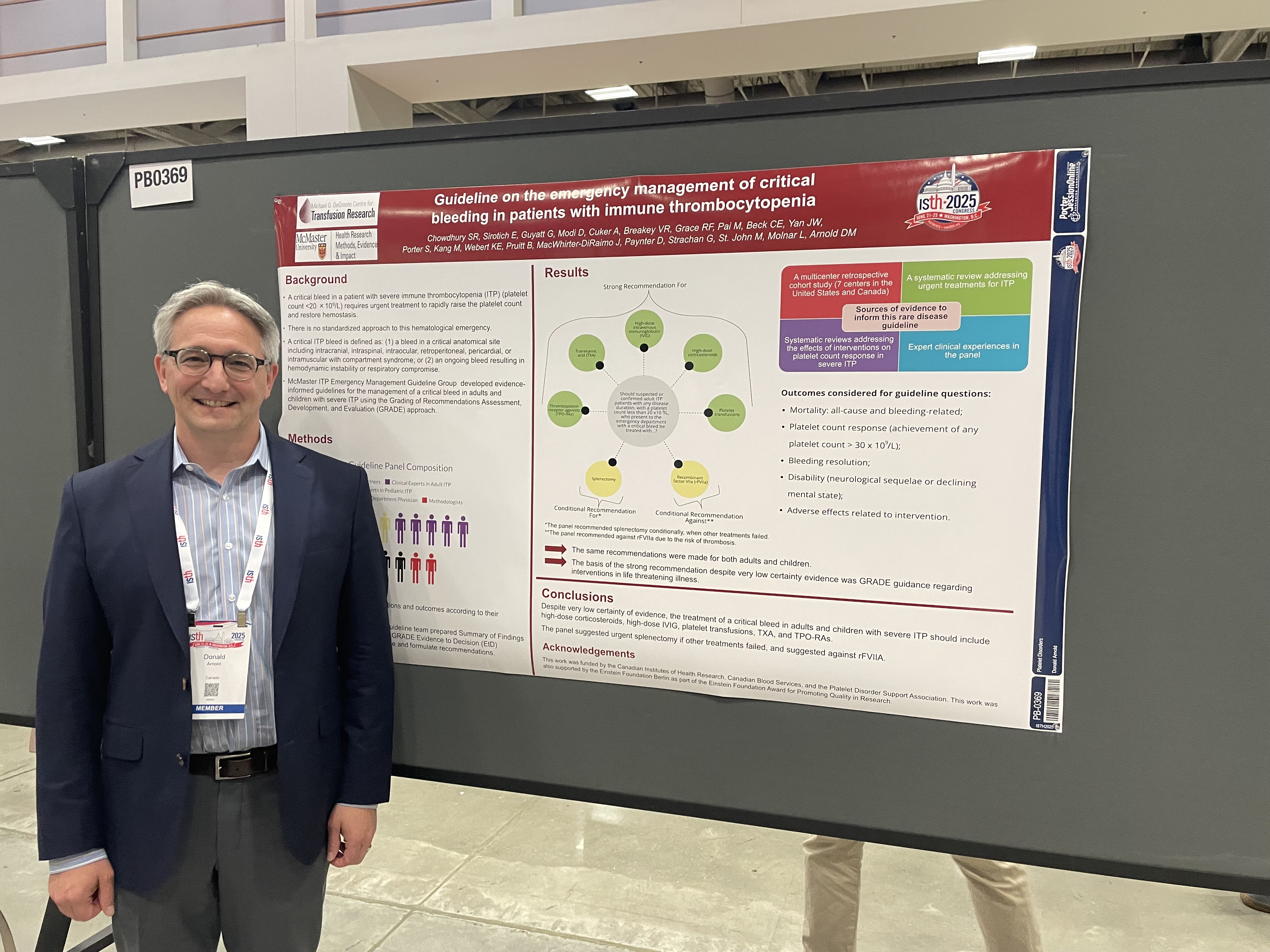
A new clinical guideline published in Blood Advances offers doctors much-needed, evidence-informed recommendations on how to manage critical bleeding in people with immune thrombocytopenia (ITP).
Although most bleeding in ITP (like bruising or nosebleeds) is mild, critical bleeding — such as intracranial hemorrhage or bleeding that causes shock — is a medical emergency requiring rapid action.
Why This Guideline MattersThe “Guideline on the Emergency Management of Critical Bleeding in Patients With Immune Thrombocytopenia” comes from the McMaster ITP Emergency Management Guideline Group, led by PhD candidate Saifur R. Chowdhury, MPH, and Donald M. Arnold, MD, MSc, of McMaster University in Hamilton, Ontario, Canada. The original research was funded by a PDSA research award and the guidelines committee includes PDSA members and ITP patients Dale Paynter, Barbara Pruitt, and Gail Strachan, along with PDSA Medical Advisor Rachael Grace, MD.
Experts on the guideline panel recognized that front-line clinicians previously lacked a standard approach when a person with ITP arrives at the emergency room with major bleeding. “Given the life-threatening nature or significant morbidity associated with critical ITP bleeding, we made strong recommendations despite limited evidence,” explained Dr. Arnold, a PDSA medical advisor.
This quote reflects the urgency behind the guidance: even though high-quality data are limited for such rare emergencies, the panel aimed to give clinicians a practical plan grounded in current best evidence.
What Doctors Are Now Encouraged to DoThe guideline recommends a combination of treatments when facing a critical bleed in an adult or child with ITP:
- High-dose corticosteroids — to calm the immune attack on platelets
- High-dose IVIG (intravenous immunoglobulin) — to raise platelet counts fast
- Platelet transfusions — to support clotting while other treatments work
- Tranexamic acid — helps stabilize clots
- Thrombopoietin receptor agonists (TPO-RAs) — medicines that stimulate platelet production
Dr. Arnold emphasized the shift in sequencing and urgency: “This is the first time that thrombopoietin-receptor agonist medications are being recommended as up-front therapy. It makes sense, because a critical bleed in a patient with ITP is a dire situation, and we really need to give patients every chance possible to raise their platelet count quickly so that the bleeding can stop.”
The panel also made recommendations about surgical and less-used options:
- Urgent splenectomy may be considered if initial therapies do not stop bleeding.
- Recombinant factor VIIa is generally not recommended because of concerns about blood clots.
Urgent splenectomy may be considered, but as a rescue step after medical therapy has not achieved meaningful hemostasis. Dr. Arnold added, “The hope is that splenectomy will not be needed if appropriate medical treatments are instituted quickly. However, the guideline panel recognized that there are some situations where splenectomy simply cannot be avoided if bleeding is uncontrollable and thrombocytopenia persists in a patient with ITP.”
What This Means for People With ITPFor patients and caregivers, this guideline doesn’t change routine care for chronic ITP, which typically involves monitoring and outpatient treatments. Instead, it gives doctors a clear framework to follow when critical bleeding occurs — helping ensure faster, more coordinated treatment in emergencies. Although critical bleeds remain rare, they can be devastating, and having a standardized emergency plan can help doctors act decisively when every minute counts.
As Dr. Arnold put it in written remarks to Heme Today, “Up until now, patients with critical bleeds have been excluded from ITP guidelines, leaving doctors scrambling to manage this life-threatening emergency on their own. Now we finally have evidence-based recommendations to guide practice in this critical situation.”
Watch Video: What Is the Purpose of Platelets?

Learn more about the role and function of platelets in ITP here.