

CONTENTS:
- Promising Treatment Option for Newly Diagnosed Children with ITP
- When It’s Not ITP: Inherited bleeding disorders can often be misdiagnosed and treated as ITP
- ITP Assistance Program
Each month, PDSA highlights interesting findings and insightful expert commentary to help enhance your understanding of ITP and partner more effectively with your care team. This month, we share the following:
Promising Treatment Option for Newly Diagnosed Children with ITP
 Researchers studied eltrombopag, a TPO-RA treatment used to raise platelet counts in people with immune thrombocytopenia (ITP). The goal was to see how well eltrombopag works to increase and maintain platelet levels over time in children with ITP who are newly diagnosed and who need treatment, the PINES trial. The first part of the trial was published recently in JAMA and the second main manuscript describing the long-term outcomes of children treated initially for 3 months with eltrombopag versus standard of care is being prepared. In addition, other manuscripts related to parts of the study like Health Related Quality of Life are also underway. The following is based on the first already-published manuscript.
Key Findings
- Better sustained platelet responses: Eltrombopag helped more patients maintain higher platelet levels over the first 12 weeks compared to standard initial treatments like steroids and/or immune-globulin (IVIg). It was shown to help patients achieve platelet counts that consistently reduced bleeding risk.
- Used in newly diagnosed cases: This was the first large, randomized trial to explore eltrombopag’s use early in the course of ITP in children. Previous studies in children (Petit and Petit2) only administered eltrombopag to children who had had their ITP for six months and after other ITP treatments had failed.
What This Means for Patients
- Eltrombopag is known to help boost and sustain platelet counts which will lower the risk of bruising or bleeding in children with ITP. In particular this trial extends the time of use of eltrombopag to the beginning of ITP for children. Many children do not need treatment at their time of diagnosis but for the ones who do, this study is very helpful.
- Finding better ways to keep platelet counts up over time is important because ITP can be unpredictable and long-lasting. Also, the quality of a child’s life with ITP can be impaired so any treatment that can make ITP easier to deal with is important.
- Just to be clear: this does NOT mean that steroids and/or IVIG did not work. Rather, they were less consistently effective than eltrombopag.
Find more information about Eltrombopag and other platelet growth factors here:
https://pdsa.org/platelet-growth-factors
When It’s Not ITP: Inherited bleeding disorders can often be misdiagnosed and treated as ITP
 In this abstract and case presentation, the article describes a patient who actually had Bernard-Soulier syndrome — a rare inherited blood disorder that makes platelets work poorly — but was initially thought to have immune thrombocytopenia (ITP), a more common condition where the immune system destroys platelets. Because the real cause was missed, the patient received ineffective treatment. The correct diagnosis was eventually made, highlighting that doctors should consider this rare condition when someone has low platelets that don’t respond to usual ITP treatments.
Find more information about other inherited thrombocytopenias or other reasons for a low platelet count here:
https://pdsa.org/when-its-not-itp
ITP Assistance Program
NORD's ITP Patient Assistance Program offers eligible individuals financial support to pay for out-of-pocket healthcare costs that are directly related to the care and treatment of this diagnosis.
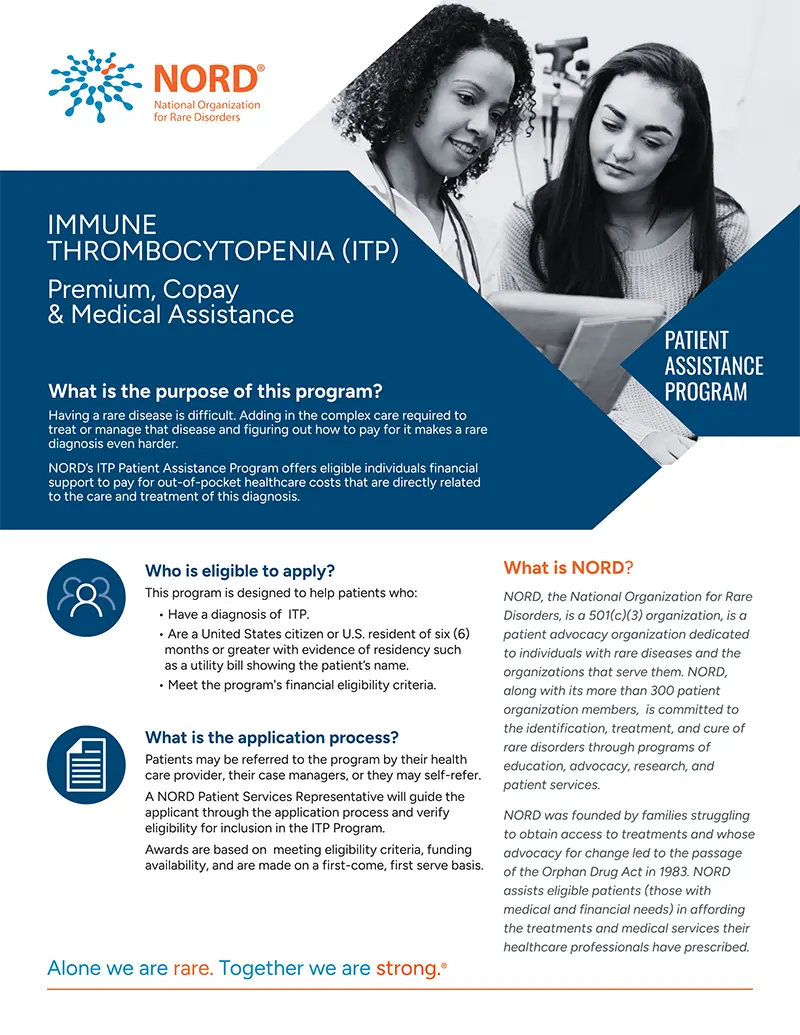
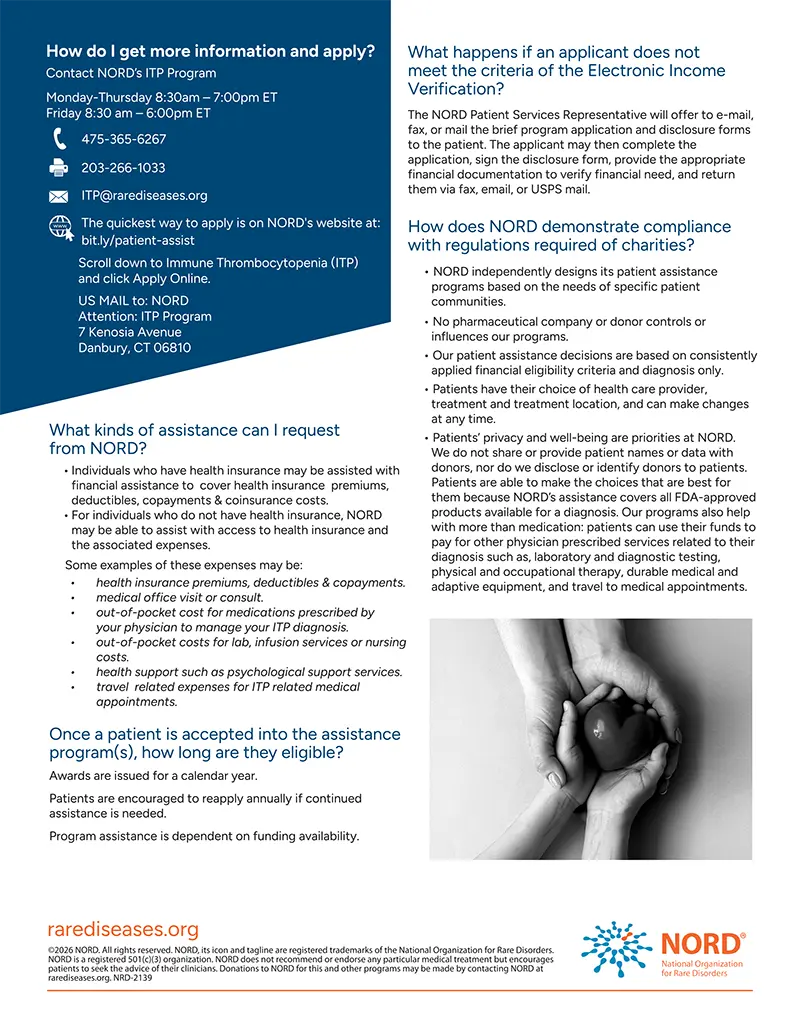
(Select the images above to view a .pdf file)
PDSA is a proud member of NORD. Find more information about other patient assistance programs in PDSA's booklet Health Insurance and Assistance Programs for ITP Patients.