


CONTENTS:
- Researchers Report Promising New Treatment Approach for ITP
- Shared Decision Making for Immune Thrombocytopenia (ITP) Treatment: Data from the ITP Natural History Study Registry
Each month, PDSA highlights interesting findings and insightful expert commentary to help enhance your understanding of ITP and partner more effectively with your care team. In this issue, we share the following two studies that were presented at this year's 67th American Society of Hematology (ASH) Annual Meeting and Exposition:
Researchers Report Promising New Treatment Approach for ITP
 Encouraging results from a major clinical study aimed at improving treatment for immune thrombocytopenia was presented during the Late-Breaking Abstract Session at ASH and simultaneously published in The New England Journal of Medicine.
In this phase 3 clinical trial called VAYHIT2, researchers tested an experimental medicine called Ianalumab, a monoclonal antibody targeting B cells. B cells drive the autoimmune response that leads to platelet destruction and increased bleeding risk in ITP. Instead of needing constant treatment, patients received only four monthly infusions of ianalumab. At the same time, they were given the TPO-RA eltrombopag (Promacta, Revolade) that was then gradually stopped.
The key goal was to see how long patients could go without their platelet counts dropping too low or needing more treatment. After about a year, more than half of the people who stopped ianalumab treatment stayed at safe platelet levels without serious bleeding — compared with only about 30% of people who got a placebo. In addition, fatigue improvement showed a mean reduction of 7.7 points with ianalumab plus eltrombopag versus 3.6 points with placebo plus eltrombopag.
What makes this research hopeful is that it points to a future where some people with ITP might keep normal platelet counts for long periods without ongoing medication, rather than needing treatment indefinitely.
Ianalumab is still being studied and is not yet approved by the FDA. Researchers will continue to follow patients from this study to see how long the benefits last and are also testing it in other autoimmune conditions.
https://www.nejm.org/doi/full/10.1056/NEJMoa2515168
Shared Decision Making for Immune Thrombocytopenia (ITP) Treatment: Data from the ITP Natural History Study Registry
Half of the patients who completed the survey had been seeing the same ITP provider for more than five years, and the typical respondent was in their mid-40s. Most lived in the United States and were treated by a specialist in blood disorders; about 85% said a hematologist was their treating clinician. Care arrangements varied, as most people named a physician as their main provider, while a smaller percentage described shared care with a nurse practitioner or being seen by a nurse practitioner alone (34%). These patterns reflect a mix of long-term provider relationships and team-based care across the group. Many respondents said that having a long-term relationship with their clinician made it easier to raise concerns beyond lab results, such as fatigue, anxiety, and the everyday impacts of living with ITP. Several people noted that team-based care sometimes allowed more time to discuss treatment options and personal preferences. Responses for children under the age of 18 were provided by legal caregivers, underscoring that family members often play a role in decision-making for younger patients.
Patients reported that clinicians were generally more open to discussing complementary approaches such as supplements, vitamins, and herbal remedies; this openness was more common among those who had been with their provider for more than five years. Emotional and non-physical symptoms were also more likely to be addressed when patients had longer relationships with their providers. Roughly three-quarters (76%) of patients said these issues were at least sometimes discussed. At the same time, formal supports such as patient support groups and programs were rarely brought up during visits. This gap points to an opportunity for providers to more routinely mention support groups and programs that can offer additional education, peer support, and decision-making tools.
Overall satisfaction with care was high; about 9 in 10 patients said they were usually happy with the care they received. Most respondents describe their clinicians as attentive, trustworthy, and respectful. Many patients said their providers took time to explain things and asked for their opinions about treatments. Most also reported that treatment options and risks were frequently discussed. Shared decision-making, where patients and providers work together to choose treatments, was reported as a priority by most respondents, and many felt it was happening in their care. There was a suggestion that clinics involving nurse practitioners may spend more time on shared decision-making and that younger patients may feel slightly less involved than older patients, though these differences were modest.
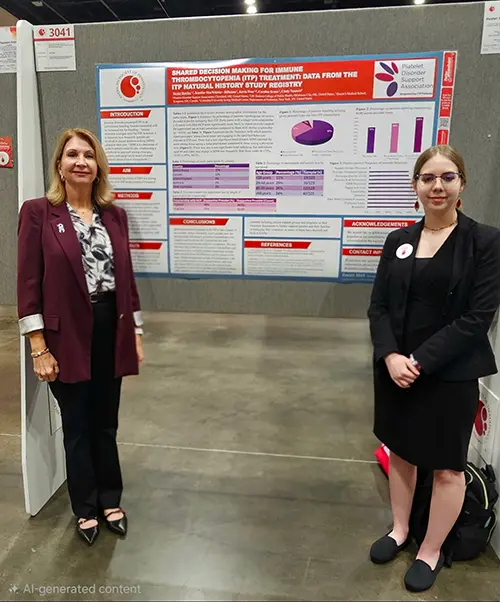 The authors concluded that shared decision-making is commonly practiced in ITP care, as experienced by patients. Also, continuity of care and multidisciplinary teams may strengthen patient-centered conversations. They highlighted opportunities to improve care by routinely mentioning support groups and decision-aid resources, by making space in visits for emotional and non-physical concerns, and by tailoring communication to younger patients who may feel less heard. Overall, the findings support efforts to give people with ITP more time, information, and options so they can take an active role in choosing treatments that fit their lives.
More key research highlights from ASH and the ITP Breakfast will be featured in the winter issue of The Platelet News, provided complimentary to PDSA members.