
Pump It Up For Platelets!
St. Thomas, ON
1st Annual Event
Saturday, September 26, 2026
Location:
Pinafore Park
Lions Club Pavilion
95 Elm Street, St. Thomas, ON N5R 1H7
Registration/Check-In: 9am EDT
Walk Begins: 10am EDT
First 100 registrants get a Pump It Up For Platelets t-shirt!
$27 CAD – Adults ($20 USD)
$14 CAD – Children ($10 USD)
* All online registrations are in US Dollars but all funds raised in Canada remain in Canada for Canadian programs and outreach
On-site registration and payment will be taken in Canadian funds
Event Organizers:
Haley and Julie Agius – agius4@hotmail.com
Tania Nichol – nicholtak68@gmail.com
Kathy and Tim Pow – rains4thkathy@hotmail.com
tim_pow@hotmail.com
Haley’s story
 I had been in the process of hockey tryouts and intensive training when I started to notice large, unexplained bruises. When I woke up covered in a reddish purple rash all over my legs and arms, and my mouth full of blood blisters I knew something wasn’t right. I was admitted to hospital where, within a few hours, I was told that they thought I had something called ITP and explained that it was destroying my platelets. I was told that I would never play contact sports again and I was devastated. This was April of 2016, just 1 week before my 16th birthday. This would be the beginning of learning to live life with restrictions and uncertainty, putting aside my current goals and dreams and learning to face my new reality head on.
In hospital, I received 2 rounds of IVIG, the second one with prednisone, but my platelets failed to rise. Next came Anti-D therapy, which only caused me to feel very sick. Over the next 4 months I was prescribed 200mg of prednisone per day for 4 day rounds to stop the extremely heavy nose bleeds I was now having, along with gastrointestinal bleeding. The steroids worked initially, but within 48 hours of treatment my platelet counts would drop back down below 10 and the bleeding would resume. I experienced blood transfusions, and a spinal tap to rule out other diagnosis. It was a painstaking process to find a medical treatment that would stabilize my platelet counts and bleeding. The result was having to deal with side-effects from trialing treatments and experiencing a roller coaster of emotions, hoping a treatment would work.
My medical team suggested I start Romiplostim (Nplate). Unfortunately, at that time, it was not yet approved for use in Children and not covered financially through the province of Ontario in Canada. My parents explored every avenue to receive coverage or financial assistance for the drug, even advocating to local government officials, but to no avail. I will be forever grateful that our community and friends in St. Thomas, Ontario stepped up and held a fundraiser walk/run and raised the money needed to get me started on Nplate. I started Nplate infusions in October 2016 and they worked to raise my platelets to a safe enough level within a few months. My medical team and my parents understood that my mental health was important and, by early December, they allowed me to play hockey again. My hematologist agreed to test my counts the day before every game to make sure I was safe to play but, if I had any signs of being low, which for me were always bruises, petechiae and blood blisters, I didn’t play. I remember him telling me he wished that I was a musician or gamer, anything less risky than contact sports, but he knew I was a competitive athlete and I will always be thankful that he respected me and accommodated my treatment plan to allow me to play the sports I love.
I received over 60 Nplate injections before my platelets stopped responding. I was quickly switched to Revolade (Eltrombopag) which I have continued to take for 9 years with little to no side effects other than the dietary restrictions which are managed by me taking my medication early morning, hours before I eat. I still do not have drug coverage and am fortunate, thanks to the PDSA, to be part of a patient support program. One of the most impactful side effects of ITP for me is the extreme fatigue I experience daily. Crushing fatigue restricts the number of hours I can work and the social events I can participate in. It effects my moods at times, and, if I don’t listen to my body and get enough sleep, I become physically sick.
ITP has changed my path but has not taken the joy out of my journey. I have gone on to receive an Honours Bachelor of Kinesiology, I have travelled extensively and have volunteered at a dog rescue organization abroad. This year I will return to school to attain a Diploma in Registered Massage Therapy. I work out daily, have a small dog walking business, continue to play women’s hockey, and enjoy time with family and friends.
Bryden’s story
 It all started with what felt like a routine change, from our pediatrician to a family doctor.
I had regular bloodwork done. We expected normal results, but instead, we got a call
that changed everything. My platelets were six, and we were told to go straight to the
emergency department. Soon after, I was referred to a haematologist at Victoria Hospital and soon after diagnosed with ITP. There had been no real warning signs, just some random bruising from sports and nosebleeds, which were common in our family. Nothing that seemed
out of the ordinary.
It all started with what felt like a routine change, from our pediatrician to a family doctor.
I had regular bloodwork done. We expected normal results, but instead, we got a call
that changed everything. My platelets were six, and we were told to go straight to the
emergency department. Soon after, I was referred to a haematologist at Victoria Hospital and soon after diagnosed with ITP. There had been no real warning signs, just some random bruising from sports and nosebleeds, which were common in our family. Nothing that seemed
out of the ordinary.
One of the hardest parts was being told I had to stop all sports. I was playing basketball and volleyball, track and then later wasn't able to snowboard, so that loss was huge. Over the next year, I was in and out of the hospital for platelet infusions and weekly bloodwork. I missed a lot of school and was really tired. Everything depended on those numbers and whether I could continue to play or had to sit on the bench.
When the infusions didn’t work, I switched to Eltrombopag. I am so thankful for the Compassionate Care Program who helps fund this, as benefits will not cover this drug. The drug regularly keeps my platelets between 20- 50. So, I still have to be very careful.
Honestly, it’s been a bit of a roller coaster. Some weeks are good, some aren’t, and it’s hard not knowing what’s coming next. But I’ve just learned to work with it and take it one week at a time.
I've met some great people who have helped me along my ITP journey and together we are excited to host the first St. Thomas Walk for ITP. It is so important to raise awareness and I'm proud to be a part of it.
Mellody’s Story
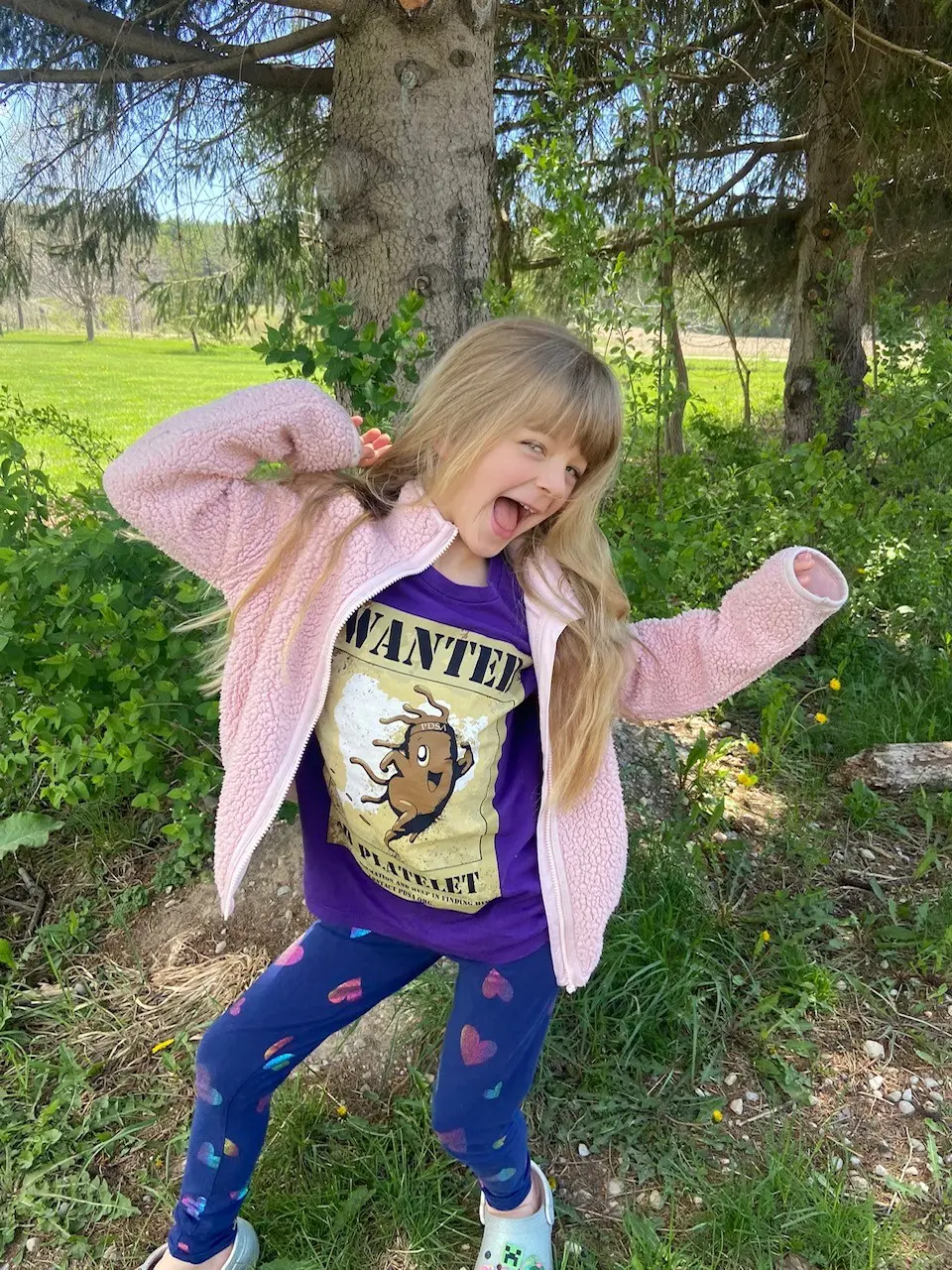 My daughter, Mellody (who we call Mellow), was diagnosed with ITP when she was three and a half years old. She will be turning seven this year. She doesn't remember life before the ITP rollercoaster. The first sign was bruising. She was a happy and active little girl who loved gymnastics, riding her scooter, and playing at the playground. It made sense that she had bruises. But then they became more frequent and often seemed to appear out of nowhere. One day, I noticed what I thought was purple marker on her face. When I looked closer, I realized it was a black eye. The bruises on her arms and legs became bigger, many had a pale lump in the centre. Mellow's Nana, who has been providing childcare to children her age for over 30 years, even said to me, "These are not normal bruises. You should get her checked out." Still, I was afraid to take her to the doctor, worried they might think someone was hurting her. Around the same time, Mellow had a few small nosebleeds, but it was the middle of winter, so I assumed the dry air was to blame.
Then one morning, Mellow woke up covered in a rash unlike anything I had ever seen before: petechiae. I took her to our family doctor that day, and we had an appointment for bloodwork the following morning. Not long after we got home from the lab, our doctor called.
"Take her to the emergency room. Her platelets are critically low. Be prepared—they may need to keep her overnight."
I don't remember much of that ER visit. My mind was overwhelmed with fear. Her platelet count was less than 5,000. She was prescribed steroids, sent home, and we met with our pediatric hematologist the following week.
The steroids worked great, but only for a few days. Our next step was IVIG. The day after her first infusion, she developed a headache that quickly turned into a severe migraine. Watching my three-year-old curled up in a ball, crying in pain, clutching her forehead, and vomiting for hours was absolutely heartbreaking. IVIG brought her platelets up and kept them there for a few weeks at a time. Over the next year, we learned to pair IVIG with steroids, keep her well hydrated, and have Tylenol, Gravol, ondansetron, ice packs, and freezies on hand to help manage the side effects. Even then, there were many times she ended up in the emergency room because the pain was unbearable and she couldn't keep anything down.
Mellow received IVIG every three to six weeks for the first 16 months. As soon as the petechiae and bruising returned, we would bring her in. They would check her platelet count, and sure enough, she would be low again. We constantly worried about keeping her above 20,000 to reduce her symptoms, and especially above 10,000 to lower the risk of spontaneous bleeding.
When Mellow was first diagnosed, we were told that 85% of children her age recover within the first year. We eventually had to accept that this was going to be chronic. The next treatment step was Eltrombopag.
 Mellow practiced swallowing Tic Tacs so she could be approved to take eltrombopag. Thankfully, it was covered by her health benefits. She gradually worked her way up to the adult dose. It helped, but not enough. We discussed trying Nplate, but unfortunately our insurance denied coverage. After a year and a half on eltrombopag, we added an immune-suppressing medication, mycophenolate (MMF), hoping the combination would work better. While these medications have helped lessen the severity of her symptoms, they still haven't been enough to consistently keep her platelets where we'd like them to be.
At this point, we're unsure what the best treatment plan is. We know that if we don't treat her, her platelet count just continues to drop. We have since stopped the MMF because having her immunocompromised only added to our anxiety, and unfortunately it didn't seem to make much of a difference. Lately, she's needed a few more rounds of IVIG and steroids, and we may have to return to that treatment more regularly.
Mellow practiced swallowing Tic Tacs so she could be approved to take eltrombopag. Thankfully, it was covered by her health benefits. She gradually worked her way up to the adult dose. It helped, but not enough. We discussed trying Nplate, but unfortunately our insurance denied coverage. After a year and a half on eltrombopag, we added an immune-suppressing medication, mycophenolate (MMF), hoping the combination would work better. While these medications have helped lessen the severity of her symptoms, they still haven't been enough to consistently keep her platelets where we'd like them to be.
At this point, we're unsure what the best treatment plan is. We know that if we don't treat her, her platelet count just continues to drop. We have since stopped the MMF because having her immunocompromised only added to our anxiety, and unfortunately it didn't seem to make much of a difference. Lately, she's needed a few more rounds of IVIG and steroids, and we may have to return to that treatment more regularly.
Living with ITP at such a young age has been incredibly challenging. Because Mellow often doesn't look sick, especially in the winter when she's wearing sweaters and pants, and many people don't realize how serious a low platelet count can be. Like us before her diagnosis, a lot of people have never even heard of ITP.
Starting school, leaving Mellow in the care of others, and constantly balancing treatment while trying to give her a normal childhood has been difficult. I received many phone calls when she was in kindergarten, all kinds of accidents and bumps to the head, most would seem minor for other children but were terrifying for us. Despite everything, Mellow continued to learn, make friends, and enjoy school.
It is frustrating not knowing what caused Mellow’s ITP or why it happened to her. The uncertainty that comes with this diagnosis brings so much anxiety, but Mellow continues to amaze us every single day.
This year, she enjoyed dance and swimming lessons. She loves board games, arts and crafts, and recently got some pet fish that she adores feeding, watching, and talking to. Her dreams are to learn to play the piano, become a stronger swimmer, and speak more languages so she can travel the world one day.
Mellow is thoughtful, kind, sweet, resilient, and unbelievably brave. She has faced more needles, medications, and hospital visits in the last few years, than most people experience in a lifetime. Yet she continues to smile, dream big, and face each day with courage. I am so proud of my little ITP warrior.