

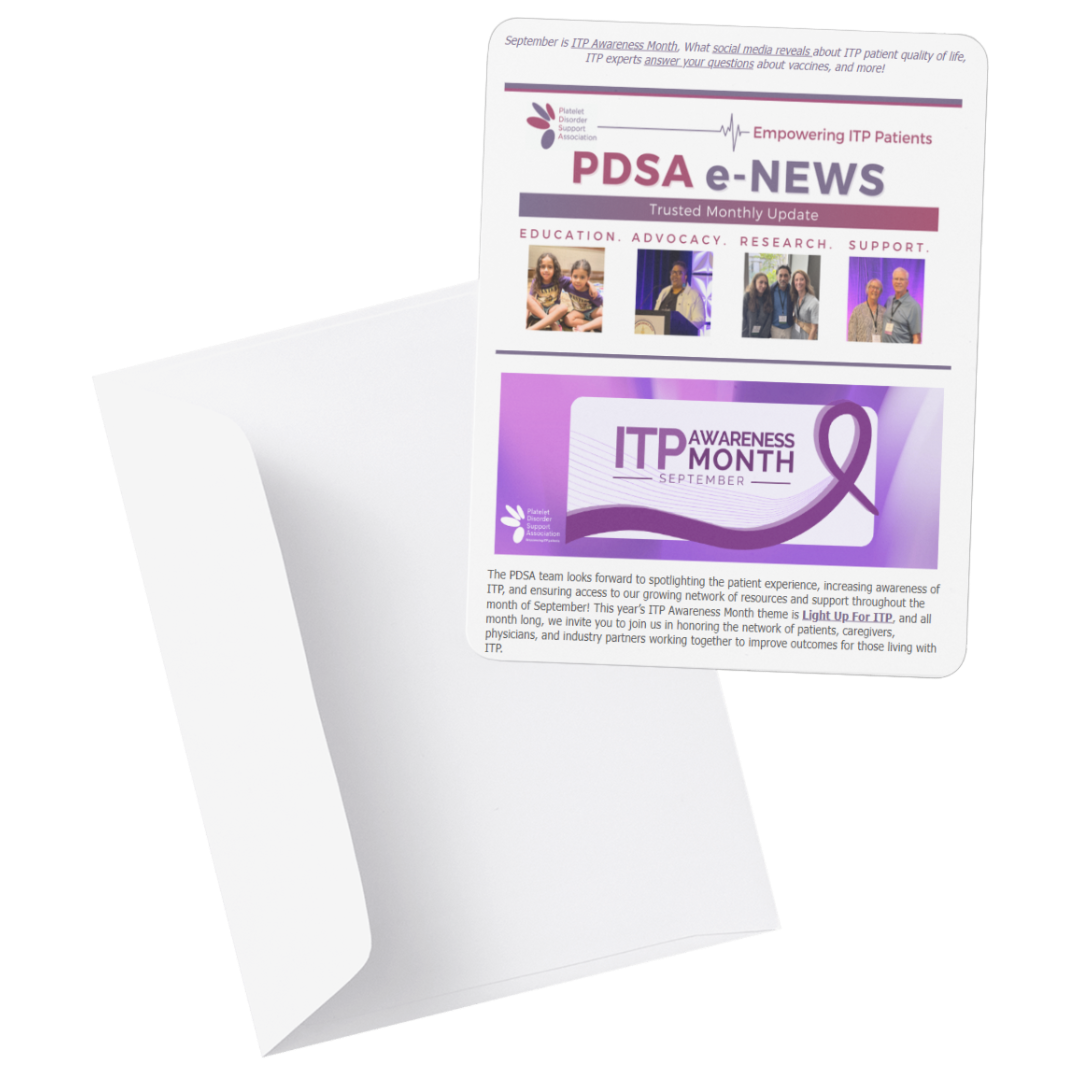
Sign up to receive the latest research updates, treatment advancements, alerts about webinars, meetings, and events, and discover ways to make an impact in the field of ITP and other platelet disorders—all straight to your inbox!
Don't miss out on crucial information and opportunities to engage with the ITP community.
Subscribe to PDSA’s email newsletter today!

Each year the annual American Society of Hematology (ASH) meeting attracts thousands of clinicians and scientists, worldwide, to learn about and report on the latest hematology research. This year's meeting, held December 6 to 9 in San Francisco, featured more than 10 hours of presentations and more than 80 pages of abstracts about ITP and related diseases. In this issue of the e-news, we report some trends.
The ASH abstract numbers are shown in parentheses. You can search on the number and read the complete abstract at: https://ash.confex.com/ash/2014/webprogram/start.html, after you 'agree' with the terms.
In this experiment doctors sent records of 20 patients with several different diagnoses to three experienced hematologists to see if they would reach the same conclusions. The ITP diagnosis matched for those with very low platelets and responded to prednisone or IVIg. However, the diagnosis often didn't match for people who had moderate platelet counts or who did not respond to those treatments. (3521) "Difficulties in Establishing the Cause of Thrombocytopenia Among Ambulatory Patients Referred to Hematology: An Agreement Study."
Researchers looked at 67 million adults in insurance databases and found 6,651 adults with primary ITP. 57% of those ITP patients had a bleeding-related episode. A brain bleed was reported in 1.1%. The study highlights the need to track both bleeding episodes and treatments to fully assess disease burden and effectiveness of treatments. (202) "Rate of Bleeding-Related Episodes (BREs) in Adult Patients with Primary Immune Thrombocytopenic Purpura (ITP): A Population-Based Retrospective Cohort Study of Administrative Medical Claims Data in the United States (US)."
People scheduled to take Rituxan should be screened for hepatitis B before getting the treatment since Rituxan can activate a hepatitis B infection. At a large hospital, researchers found screening was either not being done or not done well. They suggest a national program to make sure the screen is done and in a standardized way. (2595) "Hepatitis B (HBV) Screening in Patients Receiving Rituximab: A Comprehensive Analysis Including Comparison of Adherence by Oncologists and Non-Oncologists."
Researchers found high dose dexamethasone performed better than prednisone in newly diagnosed people with ITP. The authors suggested that dexamethasone would be a better first line treatment. (1455) "Conventional Oral Prednisone versus High-Dose Dexamethasone for Management of Adult Immune Thrombocytopenia: A Prospective Randomized Multicenter Clinical Trial."
While romiplostim (Nplate®) and eltrombopag (Promacta®/Revolade®) are similar drugs they are not completely alike. Most people who are taking Nplate can switch to Promacta without too many problems. Some people who have problems with Nplate may have a better response and easier time with Promacta, according to a Spanish study. In the study of 51 ITP patients, about half switched TPOs because of lack of efficacy. (2790) "Use of Eltrombopag after Romiplostim in Primary ITP Patients."
Now there's another good reason to know your anti-platelet antibody status. Researchers found ITP patients are more likely to respond to the TPO receptor agonists (Nplate®/Promacta®) if they don't have the anti-GP1b type of anti-platelet antibodies. This finding was also true for the patient's response to IVIg and steroids. (4190) "Response to TPO-Receptor Agonists: Role of Immature Platelet Fraction and Anti-GP1b."
In a survey of children with ITP ages 8 to 18, findings showed those who had the most side effects, were diagnosed for a shorter amount of time, were in the younger age group, and didn't participate in sports had a more impaired quality of life than those in other categories. PDSA was a prime contributor to this survey. (4843) "A Pilot Study to Assess Quality of Life in Older Children and Adolescents with Primary Immune Thrombocytopenia."
Children with chronic and persistent ITP were given eltrombopag (Promacta®) or their usual treatment. The study of 174 patients found that children given eltrombopag had higher platelet counts and a similar number of side effects compared to those receiving placebo. (1450) "PETIT and PETIT 2: Treatment with Eltrombopag in 171 Children with Chronic Immune Thrombocytopenia (ITP)."
If a patient has a splenectomy and their counts the day after the operation are close to or above 112,000 the chances are better that the splenectomy will be more successful. (1448) "The Day 1 Postoperative Platelet Count Predicts Splenectomy Response in Patients with Immune Thrombocytopenia."
People with ITP who have had a splenectomy had increased risk of infection and more cardiovascular problems (heart attacks and strokes) than people with ITP who did not have a splenectomy. In this study splenectomy success was 48% after 10 or more years. (232) "Long-Term Complications after Splenectomy in Adult Chronic Immune Thrombocytopenia with a Minimum Follow up of 10 Years. First Results from a Single-Center Case-Control Study of 140 Patients with Primary ITP."
 A recent meta-analysis by researchers in the Netherlands found several predictive factors for development of chronic immune thrombocytopenia (ITP) in children. They reviewed data from 54 studies (1975 to 2013) of children (ages 3 months to 18 years) newly diagnosed with ITP. Clinical predictors of developing chronic ITP included: female gender, absence of previous infections or vaccinations, insidious (gradual without many symptoms) onset of ITP, and higher absence of bleeding. Children older than 11 were more likely to develop the chronic form of ITP. Researchers found platelet counts of 20,000 or higher at presentation and presence of antinuclear antibodies also increased risk for chronic ITP.
Research findings showed patients treated with a combination of methylprednisolone (steroids) and IV immunoglobulin (IVIg) were more likely to develop chronic ITP, while patients treated with just IVIg alone were found less likely to develop the chronic form. The researchers wrote, "The protective effect of IV immunoglobulin is remarkable and needs confirmation in prospective randomized trials, as well as future laboratory studies..."
Reference: Heitink-Pollé KM, Nijsten J, et al. "Meta-analysis identifies predictors of chronic childhood immune thrombocytopenia." Blood, 124 (22) November 20, 2014
http://www.bloodjournal.org/content/124/22/3295?sso-checked=true
 Bridging ITP Study
Do you have ITP and need surgery?
You may be eligible for a clinical trial in Canada comparing eltrombopag with intravenous immune globulin (IVIG) before surgery.
Click here for more information
Medications were the leading cause of allergy-related sudden deaths in the US according to analysis of death certificates from 1999-2010 carried out by researchers at Montefiore Medical Center and Albert Einstein College of Medicine of Yeshiva University, in New York City. They found risk of fatal drug-induced allergic reactions was high among older patients and African American patients. A sudden, life-threatening allergic reaction is called anaphylaxis. It can occur rapidly after exposure to an allergen. Until recently data on anaphylactic deaths had not been well understood. One reason: unlike countries like the UK, the US does not maintain a national registry for anaphylaxis deaths.
Researchers analyzed death certificates from the US National Mortality Database. Medication-related anaphylaxis was the most common cause of death (58.8 %). In reports of 2,458 deaths between 1999-2010, of the culprit drugs mentioned, almost half were antibiotics, followed by radiocontrast agents (for diagnostic imaging studies) and chemotherapy drugs. They found a significant increase in fatal drug allergy deaths, from 0.27 per million in 1999-2001 to 0.51 per million in 2008-2010. They hope their findings bring increased awareness of the need for better understanding of allergy-related deaths.
Reference: Jerschow E, Lin, R, et al. "Fatal anaphylaxis in the United States, 1999-2010: Temporal patterns and demographic associations." Journal of Allergy and Clinical Immunology, September 2014.
http://www.sciencedaily.com/releases/2014/09/140930132506.htm
 Here's good news to help fight off colds and flu this winter season. A randomized, double-blind, placebo study gave cranberry juice or placebo to people during flu season. Researchers assessed the subjects' immune function over 10 weeks. Results showed cranberry juice didn't prevent the subjects from getting colds or flu; however, it did reduce seriousness of the symptoms of infections. Those receiving the cranberry juice reported fewer missed days of work/school. When researchers examined blood samples, they found gamma-delta-T cells developed faster in the cranberry group than in the placebo group. These are the immune cells that are most active in the bowels. Researchers believe the cranberries boost the activity of natural killer (NK) cells, helping the immune system fight colds and flu viruses.
Note: ITP patients with low (below 40,000) platelet counts should be careful of eating many foods with bright red, blue or purple skins (such as blueberries, red grapes, and cranberries) as they can affect the way platelets function, slowing the clotting process. See 'Warnings' on our Web site: http://www.pdsa.org/about-itp/warnings.html Discuss any concerns with your doctor.
Reference: Nantz MP, Rowe CA, Muller C. "Consumption of cranberry polyphenols enhances human γδ-T cell proliferation and reduces the number of symptoms associated with colds and influenza: a randomized, placebo-controlled intervention study." Nutrition Journal. December 13, 2013, 12:161. http://www.ncbi.nlm.nih.gov/pmc/articles/PMC3878739/
 Recent Ebola virus cases in the US have caused concern for many people, including those at the Plasma Protein Therapeutics Association (PPTA). PPTA issued a statement October 13, 2014 about the safety of immune globulin (Ig). IVIg is a common treatment for ITP patients. Patients who receive plasma protein therapies may have concerns about transmission of Ebola virus through their treatment.
The EU Center for Disease Prevention (ECDC) recommends that travelers or residents returning from an Ebola Virus Diseases (EVD) affected area should be deferred for donation of plasma for fractionation for two months after return. The Ebola virus incubation period is estimated at 25 days. PPTA's voluntary Hold of all incoming plasma for fractionation of 60 days would be adequate to allow for removal of a unit in question, if necessary. PPTA said it is not likely Ebola virus would be introduced into a plasma pool for fractionation because individuals are rejected for donation if they have viral infection symptoms, such as fever. As an additional safeguard, the PPTA Source Board has endorsed a recommendation for implementing a voluntary deferral of 60 days for donors returning from EVD affected areas.
Reference: Plasma Protein Therapeutics Association, "Ebola Virus and Plasma Protein Therapies." Statement issued Oct. 13, 2014.
http://www.pptaglobal.org/28-news/ppta-news/922-ebola-virus-and-plasma-protein-therapies
 Rigel PharmaceuticalsRigel Pharmaceuticals, Inc., in mid-July announced start of a Phase 3 clinical program for its oral SYK inhibitor, fostamatinib in patients with chronic ITP. Results of their Phase 2 clinical study (published in Blood, Vol. 113, number 14) showed fostamatinib significantly increased platelet counts of certain ITP patients including those who had failed other available treatments. Fostamatinib is a therapy that may address the autoimmune basis of ITP. The tablet, when taken, blocks activation of SYK kinase inside immune cells. When SYK is inhibited by fostamatinib it interrupts the immune response that led to platelet destruction, allowing platelets to survive.
In the Phase 3 clinical study, 150 chronic ITP patients will be randomly divided into two identical, multi-center, double-blind, placebo-controlled groups. Patients will have platelet counts of 30,000 or less. Two thirds will receive the treatment and one-third will receive the placebo. Main endpoint of the study is a stable platelet response by week 24 with counts of 50,000 or higher. Results are expected by the end of 2015.
Reference: "Rigel Initiates Phase 3 Studies of Fostamatinib in ITP." Market Watch, July 16, 2014.
http://www.marketwatch.com/story/rigel-initiates-phase-3-studies-of-fostamatinib-in-itp-2014-07-16-8183350
The Division of Blood Disorders at the US Centers for Disease Control (CDC), along with the National Hemophilia Foundation (NHF) and Harris Interactive conducted a national internet survey of young women. The survey was used to learn more about young women's thoughts on menstruation or menstrual periods (part of a woman's monthly cycle) and heavy bleeding. They wanted to understand what young women know about bleeding disorders in general and if they are familiar with signs and symptoms of a bleeding disorder. There were 1,243 young women (age 18-25) who participated in the survey.
Bleeding disorders occur when the blood cannot clot properly. Well-known bleeding disorders include von Willebrand disease (VWD) and hemophilia. Immune thrombocytopenia (ITP) is also a bleeding disorder that affects young women. Women with bleeding disorders are more likely to experience heavy bleeding (called menorrhagia) during their periods and excessive blood loss during and after childbirth.
CDC and the NHF will use the findings in developing health promotion materials to encourage women with bleeding symptoms to see a doctor.
References: "New Survey Findings on Young Women and Bleeding Disorders." Centers for Disease Control and Prevention (CDC), Oct. 8, 2014. http://www.cdc.gov/ncbddd/blooddisorders/women/features/keyfinding-womenbleedingdisorders.html & http://www.cdc.gov/ncbddd/blooddisorders/women/research.html & http://www.cdc.gov/ncbddd/blooddisorders/women/research.html
 Apples have been known to have many health benefits. In a study that was the first of its kind, a Washington State University research team found that among seven varieties of apples tested, Granny Smiths (a green apple) appeared to have the most beneficial effect on good gut bacteria in diet-induced obese mice. When researchers compared feces of lean mice to that of obese mice fed Granny Smith apples, the proportion of helpful bacteria strains was very similar. Granny Smith apples are high in non-digestible fiber and polyphenols (a type of antioxidant). Even after being chewed and in stomach acid, the apple compounds reach the colon unscathed. Bacteria in the colon ferment the compounds, producing butyric acid. That then spurs growth of friendly gut bacteria. The researchers said around 35% of American adults are obese and at risk of conditions such as heart disease, diabetes, and stroke. The gut bacteria of obese people is usually impaired. Gut bacteria imbalance, usually determined by the type of food we eat, can cause chronic inflammation in the body. The researchers say by re-establishing the balance of gut bacteria by eating Granny Smith apples, the inflammation may be reduced.
References: Giuliana Noratto, et al., "Assessing non-digestible compounds in apple cultivars and their potential as modulators of obese faecal microbiota in vitro." Food Chemistry, September 2014: http://www.sciencedirect.com/science/article/pii/S0308814614005251 & https://news.wsu.edu/2014/09/29/an-apple-a-day-could-keep-obesity-away/#.VE2BF_nF-F8
 Researchers at St. Michael's Hospital in Toronto, Canada found the naturally occurring protein fibronectin stops bleeding and also prevents life-threatening clots. Fibronectin switches its function from stopping bleeding to stopping overactive blood clots. Most treatments that stop bleeding actually cause blood clots while treatments that prevent excessive blood clotting increase risk of serious bleeding. Dr. Heyu Ni, principal investigator, said when fibronectin was given to mice after an injury or given to mice treated with blood thinners, the fibronectin offered a win-win solution.
The findings are important for surgery and traumatic injuries, which often require large amounts of blood transfusions. Experts disagree as to which blood products are most helpful for controlling bleeding. More heavily refined blood products strip away most proteins found in the blood, including fibronectin. Dr. Ni's research indicates that the less-refined blood product that contains fibronectin helps stop bleeding more effectively.
St. Michael's Hospital. "Protein in plasma may one day change transfusions." Science Daily, 2 Sept 2014.
http://www.sciencedaily.com/releases/2014/09/140902205337.htm
Wang Y, Reheman A, Spring CM, Kalantari J, et al. "Plasma fibronectin supports hemostasis and regulates thrombosis." Jour Clin Investigation, 2014; DOI: http://www.jci.org/articles/view/74630
Photo credit: St. Michael's Hospital
 If you've ever dreaded getting a blood draw or receiving your IVIg treatment, you can breathe a sigh of relief. The US Food and Drug Administration (FDA) has now given the company, MMJ Labs LLC, 510(k) clearance with expanded indications for the Buzzy®. The approved handheld device controls pain associated with injections, blood draws, and IV starts. The Buzzy® device is a high-frequency vibrating ice pack that confuses the body's nerves thus dulling or eliminating sharp injection pain. The FDA's approval was supported by more than eight clinical trials. Buzzy® inventor and CEO of MMJ Labs, Amy Baxter, MD, said, "We are thrilled to gain FDA clearance of Buzzy's use for injections and intravenous access."
Note: Through its ITP Poke-R-Club for Kids PDSA is offering a Buzzy® to ITP children, whose parents are PDSA members. See details here: http://www.pdsa.org/resources/itp-poke-r-club.html
"Buzzy4PainRelief Announces 510(k) Clearance from FDA." Press Release, MMJ Labs LLC, 2014 September 11. http://www.prweb.com/releases/2014/09/prweb12158304.htm
For more about Buzzy® visit the Web site:
http://buzzy4shots.com/health-care/clinical-support/
Patients can now see results for various medical tests, including complete blood counts (CBCs), allergy tests, and urinalysis. In April 2014 a new federal rule went into effect. Results must be available upon request within 30 days; no doctor's authorization is required. The 30-day window gives doctors a chance to review the test results and meet with the patient to discuss if findings are complex. Lab companies like Quest Diagnostics are launching new secure patient web sites, such as MyQuest by Care360. Patients can view their results for no cost.
Past research showed it was common for abnormal test results to fall through the cracks, delaying care for some patients. Some patients said doctors were too busy or even reluctant to share test results with them. In a 2013 Kaiser survey, patients who viewed their lab reports online overwhelmingly reacted positively. Many patients said ready access to their test results encouraged them to learn more about the cells in their blood and their own illnesses.
"Landro, L. "Medical Test Results Become Patient Friendly," Health & Wellness D2, The Wall Street Journal, 2014, Sept. 16. http://online.wsj.com/articles/medical-labs-make-test-results-easier-for-patients-to-understand-1410822452
 Researchers found several widely used artificial sweeteners, including saccharin, aspartame, and sucralose, caused mice to experience higher risk of glucose intolerance. That condition can lead to diabetes and obesity. The sweeteners studied: saccharin, aspartame, and sucralose are commonly known as Sweet n' Low, Equal, and Splenda. The study's co-author, Eran Segal, biologist at the Weizmann Institute of Science in Israel, said, "We are talking about very dramatic increases."
In a separate study, the scientists analyzed 400 people and found gut bacteria of those who used artificial sweeteners were quite different from those who did not. Researchers said their findings are preliminary. They could not recommend whether people should or should not use artificial sweeteners. A scientist at the nonprofit Center for Science in the Public Interest praised the research. She said people shouldn't see the findings as suggesting sugar-sweetened beverages are preferable to those with artificial sweeteners.
Dennis, B. "Artificial Sweeteners Could Cause Spikes in Blood Sugar." Politics & The Nation, A3, The Washington Post, 2014, Sept. 18. http://www.washingtonpost.com/national/health-science/study-suggests-sweeteners-could-contribute-to-obesity-and-diabetes/2014/09/17/c3c04ea6-3dc2-11e4-b03f-de718edeb92f_story.html
 It is scary when children with ITP have persistent bleeding. There is good news from a study of 34 children with primary immune thrombocytopenia who had persistent bleeding symptoms. Researchers found that a combination therapy of IVIg and steroids was effective in raising their platelet counts (to 50,000 or higher) to control active bleeding. The combined treatment was considered well-tolerated by the patients. Combined therapy was given to 12 patients with newly diagnosed ITP who had not responded to treatment with either IVIg or steroids and to 22 patients with persistent, chronic ITP who had needed frequent treatments of either steroids or immunoglobulins to control active bleeding.
Prodi E, Giordano P, Rivetti E, et al., "Efficacy of combined intravenous immunoglobulins and steroids in children with primary immune thrombocytopenia and persistent bleeding symptoms." Blood Transfus. 2014 July: 12(3): 340-345.
http://www.ncbi.nlm.nih.gov/pubmed/24887226
 Outcomes were analyzed from three ITP trials that allowed self-administration (SA) of romiplostim (Nplate®) injections versus administration by a healthcare provider (HCP) in a clinical setting in ITP patients who had achieved stable dose for 3 or more weeks. The self-administered groups had greater percentage of patients achieving the target platelet range (55-58% in SA vs 40-52% in the HCP) and a greater percentage of weeks with a platelet response (75-78% vs 47-76%, respectively). In addition, the rate of romiplostim discontinuation was lower in the self-administered group. Researchers concluded that in adult patients receiving romiplostim, self-administration compared well to healthcare provider administration when it came to effectiveness and safety. Allowing ITP patients to self-administer romiplostim is a feasible option for certain ITP patients.
Selleslag D, Bird R, Altomare I, et al., "Impact of self-administration of romiplostim by patients with chronic immune thrombocytopenia compared with administration by a healthcare provider." Eur. J. Haematol. 2014, July 14, [Epub ahead of print] http://www.ncbi.nlm.nih.gov/pubmed/25039799
Blood is among the most precious and most perishable of commodities in health care. Red cells may last five weeks, but platelets which are key to clotting and preventing bleeding, last less than a week. Because of short shelf life of blood products hospitals across the country waste huge amounts of blood worth millions of dollars annually.
At the University of Pittsburg Medical Center (UPMC) ways are being found to reduce this waste. Buying and storing only what the hospital needs is key but with platelets that is easier said than done. Platelets have the shortest shelf life of any blood cells, and are very temperature sensitive. If frozen or even refrigerated the transfused platelets will leave the person's system too quickly. UPMC redesigned their blood supply chain and changed the standards of when patients would require a blood transfusion. They reduced the number of blood donations by patients prior to operations, which the hospital found were unused in 50% of cases and had to be thrown out, wasting thousands of dollars.
"Bill Tolland, "UPMC is finding ways to squeeze savings, prevent waste." Pittsburgh Post-Gazette, 2014 July 29.
http://www.post-gazette.com/news/health/2014/07/29/UPMC-is-finding-ways-to-squeeze-savings-prevent-waste/stories/201407270062
 We know because celery is low in calories (16 calories per cup) it has been popular with dieters. But there's much more to celery than people realize. Celery is an excellent source of fiber that lowers risk for colon cancer. The bright green vegetable offers 8-9 percent of the daily requirement for vitamin A, folate, and potassium. It contains smaller amounts of manganese, copper, magnesium, and calcium, plus vitamin C, B6, and niacin. Most surprising, one cup of celery contains 37 percent of the daily requirement for Vitamin K, which people with ITP know is an important vitamin for production of healthy platelets.
Celery contains flavonoids like lutein and beta carotene that studies have shown lower inflammation and enhance the immune system. Recent studies found that celery reduced memory loss and brain inflammation in mice. For centuries Ayurvedic medicine has used celery for colds and flu, digestion problems, and liver and spleen disorders. So go ahead and enjoy crunchy fresh celery in your next salad, stir fry, soup, or veggie tray!
"What is Celery Good For?" Dr. Mercola Online newsletter, August 8, 2014.
http://foodfacts.mercola.com/celery.html
 Octapharma USA announced July 15, 2014 that the US FDA has approved Octagam 10%, an immune globulin intravenous 10% (100 mg/mL) liquid for treatment of adults with chronic immune thrombocytopenia (ITP). Octagam 10% is a sterile preparation of highly purified immunoglobulin G (IgG) derived from large pools of human plasma. Octapharma USA is the US subsidiary of the Swiss company Octapharma AG, which is a global human protein products manufacturer. The FDA's approval is a significant Octapharma milestone and opens up new treatment options for patients. Octagam 10% demonstrated safety and efficacy in a clinical trial of 66 patients with chronic ITP. Headaches and rapid heart rates were the most common treatment-related adverse events observed. Thromboses (blood clots) are a risk factor with all immune globulin intravenous products, including Octagam 10%. The new treatment is expected to be available in the US in September 2014.
"Octapharma USA Announces FDA Approval of Octagam 10%, Expanding its Immune Globulin Therapy Portfolio." Press Release, Octapharma USA, 2014, July 14.
http://www.businesswire.com/news/home/20140715006419/en/Octapharma-USA-Announces-FDA-Approval-Octagam-10#.U9AEtPldV0U
 NovoSeven® RT for Treatment of Patients with Glanzmann's Thrombasthenia (GT) is FDA Approved
A Danish global healthcare company Novo Nordisk announced July 7, 2014 that the US Food and Drug Administration (FDA) has approved NovoSeven® RT (Coagulation Factor VIIa [Recombinant]) as the first recombinant treatment for bleeding episodes in patients with the rare genetic blood disorder Glanzmann's Thrombasthenia (GT) who do not see a rise in circulating platelets after blood transfusions. These patients have lifelong susceptibility toward bleeding episodes, sometimes severe. GT affects one in one million people globally and occurs because of missing surface proteins on platelets, which seriously affects the blood's ability to form strong clots. FDA approved NovoSeven® RT based on evidence collected from the global Glanzmann's Thrombasthenia Registry (GTR), which includes 218 patients and over 1,000 bleeding and surgical events. The data supported the effectiveness and safety of the new drug in treating bleeding and preventing bleeding during surgeries for GT patients.
"FDA Approves NovoSeven® RT for the Treatment of Glanzmann's Thrombasthenia (GT) With Refractoriness." PR Newswire, press release, 2014, July 7.
http://press.novonordisk-us.com/2014-07-07-FDA-Approves-NovoSeven-RT-for-the-Treatment-of-Glanzmanns-Thrombasthenia-GT-With-Refractoriness
We know that early diagnosis of an illness means a better treatment outcome. But testing is often difficult, painful and costly. Now we can breathe a sigh of relief...there are now simple breath tests that detect diseases, sometimes before the patient shows outward symptoms. Researchers have already studied whether breath tests could detect liver, kidney and heart disease. Some ITP patients have had breath tests for H. pylori bacteria in the stomach. Now a recent pilot study showed that a breath test was 100 percent accurate in detecting patients with heart failure. Lung cancer was another disease picked up by breath test, with about 80 percent accuracy. Dr. Raed Dweik, Director of the Pulmonary Vascular Program at the Cleveland Clinic said, "Anything in your blood that is potentially volatile will end up in your breath."
"Breath Test Spots Diseases." Medical Breakthroughs Reported by Ivanhoe (online newsletter), July 16, 2014.
http://search.ivanhoe.com/channels/p_channelstory.cfm?storyid=33492&channelid=CHAN-100021
 We know about the dangers of too much sun during the summer months. But a new growing warm weather problem poses real danger -- bug bites. Usually mosquito bites are a minor nuisance during summer. However, more people are contracting dangerous bug-borne diseases. West Nile virus, a well-known mosquito-related infection, can be hard to diagnose. It can take two weeks to develop symptoms, which include fever, headache, rash, fatigue, and joint aches and pains. In serious cases patients develop a neuroinvasive form of West Nile where the virus infects the brain, causing meningitis (inflammation of brain membrane) or encephalitis (inflammation of the brain itself). Diagnosis is complicated and there's currently no remedy. Doctors recommend lots of fluids, rest, and pain relievers.
A more recent bug-borne virus called Chikungunya has moved from South America and the Caribbean into Florida and spread throughout the U.S. is considered imminent. The first symptom is fever, about a week after the bite. Next comes unbearable joint pain, fatigue, rashes, headaches, and muscle aches. Symptoms can linger months, even years. There is no cure or vaccination to prevent it. Both viruses are spread only by infected mosquito bites, mainly by the Asian tiger mosquito, a very small, daytime feeder. When outdoors take precautions to cover up, wear non-DEET insect repellant, avoid using pesticides (toxins), and be sure your yard is not harboring mosquito-breeding with standing water.
Connealy, Leigh E., MD. "The Bad Bugs of Summer - and How to Avoid Them." Newport Natural Health Letter, online newsletter. July 1, 2014.
http://www.newportnaturalhealth.com/2014/07/stop-mosquitoes-to-prevent-west-nile-virus/
GlaxoSmithKline (GSK) announced results from the Phase III PETIT2 study that evaluated efficacy of eltrombopag (Promacta® in the U.S., Revolade® in Europe and other countries) vs. placebo in children with chronic ITP. Eltrombopag caused significant increase in platelet counts for 6 to 8 weeks in about 40% of patients treated with eltrombopag compared to those who received the placebo (3.4%). GSK reported the results at the 19th European Haematology Association (EHA) Annual Congress, June 12-15, in Milan, Italy. The children, from 12 countries, with chronic ITP had previously failed other standard therapies. No new safety concerns were observed. Eltrombopag is not approved or licensed for pediatric use anywhere in the world. GSK will continue assessing the potential of eltrombopag in child ITP patients and plans to move forward with regulatory submissions for pediatric indication in chronic ITP later this year.
GSK announces results of Phase III PETIT2 study of eltrombopag (Promacta™/Revolade™) in paediatric patients with chronic immune thrombocytopenia. Press Briefing, 19th European Haematology Association Annual Congress, Milan, Italy, June 12-15, 2014.
http://www.gsk.com/media/press-releases/2014/gsk-announces-results-of-phase-iii-petit2-study-of-eltrombopag--.html
Gómez-Almaguer D, Herrera-Rojas M, Jaime-Pérez J C, Gómez-De León A,, et al. "Eltrombopag and high-dose dexamethasone as frontline treatment for newly diagnosed immune thrombocytopenia in adults." Blood. 2014, May 6.
http://www.ncbi.nlm.nih.gov/pubmed/24802773
U.S. emergency rooms are reporting increases of 10% or more in patients using emergency rooms, rather than going to primary care doctors. A goal of the Affordable Care Act (also called Obamacare) was to reduce pressure on the nation's emergency rooms by expanding Medicaid and offering poor people better access to primary care. Half of the ER doctors responding to an American College of Physicians survey said they have seen more ER visits since Jan. 1. A majority expected visits to continue rising the next three years. A major cause has been shortage of primary care doctors, with too few to handle all the newly insured patients. Almost half of physicians do not accept Medicaid patients. Also, poor people often cannot take time from work to get to primary care offices open only during the day while ERs operate around the clock. Many uninsured patients are accustomed to getting care in the ER setting and haven't taken steps to find a primary care doctor. For a number of years crowding and wait times may increase for everyone. Average cost of an ER visit is $580 more than a trip to the doctor's office.
Ungar, L. "More patients flocking to ERs under Obamacare." The (Louisville, KY) Courier-Journal, June 8, 2014...
http://www.usatoday.com/story/news/nation/2014/06/08/more-patients-flocking-to-ers-under-obamacare/10173015/
The World Cancer Report 2014 issued this spring by the International Agency for Research on Cancer (IACR) emphasized the need for prevention and changes in the lifestyle behaviors that lead to cancers. These behaviors include smoking tobacco, drinking alcohol, being overweight/obese, and not exercising. The report included contributions from more than 250 scientists worldwide and emphasized that cutting tobacco use was the single most important way to prevent many deadly cancers. Obesity was also shown to be a modifiable risk factor for many types of cancer. To avoid cancer, the report urged people to eat a diet high in fruit and vegetables, decrease consumption of sugar, avoid alcohol and tobacco, and increase physical activity.
Chustecka, Z. "Cancers caused by lifestyle behaviors: experts urge action." www.medscape.com 2014, Feb. 6.
Activated platelets tend to aggregate (leading to clotting) but they cannot do so when the platelet numbers are low, as in ITP. Researchers examined platelet activation in 55 ITP patients and 55 controls, with and without ADP (adenosine diphosphate) stimulation both before and after the patients received steroid treatment. They found that platelets in ITP patients exist in an activated state. The fold activation of platelets treated with ADP was more in healthy controls than in ITP patients. Treatment with steroids caused platelets in steroid-responsive patients to respond more to the ADP activation. The researchers concluded steroids may cause changes in the ability of platelets to become activated with an agonist like ADP. Their results offer new insights into how steroid therapy aids in treating ITP.
Bhoria P, Sharma S, Varma N, Malhotra P, Varma S, Luthra-Guptasarma M. "Effects of steroids on the activation status of platelets in patients with immune thrombocytopenia (ITP)." Platelets. 2014 Mar 11.
http://www.ncbi.nlm.nih.gov/pubmed/24617442
 B-cell depletion from rituximab treatment may impair vaccine responses and increase risk of infection in ITP patients. Researchers investigated the response to Streptococcus pneumonia vaccines given to 24 patients six months after they received rituximab treatment. The study found antibody responses to vaccines were impaired at least six months after rituximab. The findings showed importance of timing of vaccinations and the possible means of infection after ITP patients receive rituximab.
Nazi I, Kelton JG, Larche M, Snider DP, Heddle NM, Crowther, MA, Cook RJ, Tinmouth AT, Mangel J, Arnold DM. "The effect of rituximab on vaccine response in patients with immune thrombocytopenia." Blood 2013 Sep 12; 122(11):1946-53. http://www.ncbi.nlm.nih.gov/pubmed/23851398
Researchers have developed a new optical device about the size of a tissue box that provides rapid test results with only a small amount of blood. The technique, called laser speckle rheology (LSR), was found very sensitive to the coagulation of blood. It allows doctors to evaluate a patient's coagulation status in real-time especially in operating rooms, emergency departments, and intensive care units for patients with any type of coagulation disorder. This would aid doctors in quickly deciding how much blood to give to a bleeding patient. Clinical testing at the point of care is the next phase of research.
Tripathi M, et al, "Assessing Blood Coagulation Status with Laser Speckle Rheology," Biomedical Optics Express, Vol. 5, Issue 3, pp. 817-831 (2014).
http://www.opticsinfobase.org/boe/abstract.cfm?uri=boe-5-3-817
 In the past, we learned how BPA (bisphenol A) a chemical used in the linings of canned food, plastics, and cash-register receipts could disrupt hormones and have adverse effects on humans and wildlife. Since then many companies switched to thermal paper cash-register receipts made with an alternative chemical, bisphenol S (BPS). Now recent research shows that BPS also disrupts the hormone estrogen, even at low levels. With BPS on receipts that we handle every day it is very easy to get residue on the fingers and hands. To reduce your exposure, always wash hands after handling receipts and throw them away if unneeded. Some stores now offer electronic, online receipts instead of paper.
http://www.scientificamerican.com/article/bpa-replacement-also-alters-hormones/?print=true
http://articles.mercola.com/sites/articles/archive/2012/06/20/bpa-free-plastic-still-toxic.aspx
 What causes decreased platelet count in immune thrombocytopenia (ITP) is not entirely understood. Researchers in Argentina investigated the key step of proplatelet formation (PPF) by studying the effect of ITP plasma in thrombopoiesis. Megakaryocytes taken from cord blood were cultured along with recalcified plasma from ITP patients. The PPF was evaluated using microscopic analysis. The ITP patient samples caused a dose-dependent inhibition in PPF and decreased the complexity of the proplatelet structure. Results showed there is involvement of auto-antibodies in inhibiting thrombopoiesis. The findings indicate new mechanisms contribute to decreased platelet counts in ITP patients.
Lev PR1, Grodzielski M, Goette NP, et al. "Impaired proplatelet formation in immune thrombocytopenia: a novel mechanism contributing to decreased platelet count." Br J Haematol. 2014. Mar 27.
http://www.ncbi.nlm.nih.gov/pubmed/24673454
A Canadian study has found that currently available treatments for ITP are inadequate since they do not reverse the disease process and usually do not result in long-lasting remissions. Many of the treatments produce serious side effects including infection and potentially thrombosis (blood clots). New treatments being developed work differently from the current group. They target certain key steps in the ITP disease process. These include the platelet auto-antibodies, T-cells, and signals for platelet destruction. Targeted therapies for ITP patients could improve disease outcomes while limiting difficult side effects.
Shih A, Nazi I, Kelton JG, Arnold DM. "Novel treatments for immune thrombocytopenia." Presse Med. 2014 Apr;43(4 Pt 2):e87-95.
http://www.ncbi.nlm.nih.gov/pubmed/24656294
 Military statistics show minimizing major blood loss within the first 10 minutes after traumatic injury is crucial to survival. Hemorrhage is the leading cause of battlefield deaths. Large deep wounds in the upper legs and torso are often difficult areas for applying an external tourniquet. Researchers have developed a pocket-sized syringe that can inject directly into the wound site a sealed barrier from tiny, pill-sized sponges made of sterile cellulose (wood pulp) coated with an antimicrobial clotting agent called chitosan. The sponges expand up to 15 times their size as they soak up blood and expand within the deep wound, clumping together to form a solid mass that prevents excessive bleeding while also speeding up clotting. The injectable sponges may soon be absorbable within the body as well. These would be quite effective for nosebleeds as well. The injectable dressings, if FDA approved, may be available this summer.
Nguyen T. "An Injectable Bandage Can Stop Heavy Bleeding in 15 Seconds," Smithsonian.com, Feb. 12, 2014.
http://www.smithsonianmag.com/innovation/injectable-bandage-can-stop-heavy-bleeding-15-seconds-180949723/?no-ist
 This past summer the Center for Science in the Public Interest (CSPI), a food safety advocacy group, downgraded its rating for the artificial sweetener, sucralose (common trade name Splenda®) from "safe" to "caution", pending peer review of a study by an independent Italian lab that had found the sweetener caused leukemia in mice. CSPI said it awaits the Italian study's review before deciding what long-term safety grade to assign to Splenda. CSPI said previously the only long-term animal feeding studies had been done by the sucralose manufacturer. CSPI had already rated as "avoid" several other artificial sweeteners, including saccharin, aspartame, and acesulfame potassium. A sweetener obtained from the plant stevia is currently considered "safe" by CSPI. To help avoid risks of both sugar and artificial sweeteners, CSPI encourages people to make a healthy switch to water, seltzer, diluted fruit juices, unsweetened flavored waters, and unsweetened tea.
Nordqvist, C. "How Safe Is Splenda (Sucralose)?." Medical News Today. (2013, June 25). Retrieved from
http://www.medicalnewstoday.com/articles/262475
http://news.msn.com/us/splenda-goes-from-safe-to-caution-after-leukemia-found-in-mice
 New Study Aims to Develop Improved Artificial Platelets
With a $1.9 million NIH grant a Case Western Reserve University research team is collaborating with researchers at the Cleveland Clinic Foundation to develop injectable artificial platelets that would halt bleeding by sticking to bleeding sites and signaling natural platelets to be attracted to the site. While artificial platelet research has been ongoing the past 20 years, it mainly focused on 'clustering' mechanisms of platelets. This is the first research to integrate platelets' 'stickiness' function of sticking to an injury site by specific molecular interactions. Researchers say the new platelet design may be more effective in managing bleeding disorders compared to designs in the past. The study aims to uncover the details of how the stickiness and clustering work together to maximize clotting ability. http://phys.org/wire-news/155397095/cwru-wins-19-million-grant-to-lead-artificial-platelet-study.html
http://cwru-daily.com/news/cwru-wins-1-9-million-grant-to-lead-artificial-platelet-study/
 Eltrombopag Increased Platelet Counts in Chronic ITP Patients Prior to Surgery
ITP patients with low platelet counts face increased risk of bleeding during medical and surgical procedures. Treatment guidelines recommend a platelet count of at least 50,000/µL before minor surgery and at least 80,000/µL before major surgery. A retrospective analysis found that a majority of the chronic ITP patients who received eltrombopag (Promacta®) and who experienced increased platelet counts met current pre-procedural platelet count recommendations. Patients receiving eltrombopag also had reduced need for additional ITP treatment after the procedure. The study explored invasive, non-dental procedures associated with bleeding risk (hemostatic challenges) in 494 chronic ITP patients in five phase2/phase 3 studies of eltrombopag.
Tarantino M, Bakshi K, and Brainsky A. "Hemostatic challenges in patients with chronic immune thrombocytopenia treated with eltrombopag." Platelets, Feb. 2014; 25(1): 55-61.
http://www.ncbi.nlm.nih.gov/pmc/articles/PMC3913069/
 Is Your Hospital Safe?
ITP patients have often been hospitalized as part of their treatment and care. But just how safe is your hospital? At least 440,000 Americans die each year from preventable medical errors in hospitals, according to a study in the Journal of Patient Safety. Changes to improve the situation include not only doctors, nurses and hospital staff but also increased participation by patients in their own health-care decisions. Patients need to ask questions and create a partnership with their doctor before they are in the hospital. The major problems that can be life-threatening include: diagnostic errors and receiving the wrong treatment, hospital-acquired infections, and surgery on the wrong body part.
http://www.everydayhealth.com/news/how-safe-your-hospital/
 New Studies Show How Dark Chocolate Helps the Cardiovascular System
We've been hearing of the benefits of eating dark chocolate for many years but only recently scientists discovered the exact reasons why. First, in a study at Louisiana State University researchers report that certain good bacteria in the stomach gobble the chocolate and ferment it into anti-inflammatory compounds that are good for the person's heart. In a second study researchers found that dark chocolate helps restore flexibility to human arteries while preventing white blood cells from sticking to the walls of blood vessels. Arterial stiffness and white blood cell adhesion are known risk factors for atherosclerosis. So go ahead and enjoy some chocolate this spring.
American Chemical Society. "Precise reason for health benefits of dark chocolate: Thank hungry gut microbes." ScienceDaily. 18 March 2014.
https://www.facebook.com/sciencedaily/posts/432767973535095?stream_ref=10
"Why dark chocolate is good for your heart." Federation of American Societies for Experimental Biology (FASEB) Journal, February 2014.
Esser D, Mars M, Oosterick E, Stalmach A, et al. "Dark chocolate consumption improves leukocyte adhesion factors and vascular function in overweight men." FASEB J March 2014 28:1464-1473.
http://www.ivanhoe.com/channels/p_channelstory.cfm?storyid=32905
 TPO Levels Help with ITP Diagnosis and Predicting Response to TPO Treatments
When thrombopoietin (TPO) levels were measured in 118 healthy volunteers and in 88 patients with abnormal platelet counts the average TPO level in healthy volunteers was 39 (7-99) pg/mL (picograms per milliliter). In the 88 patients with abnormal platelet counts, 39 had thrombocytopenia from platelet destruction and 49 had thrombocytopenia from low platelet production. For those with platelet destruction the average TPO level was 63 (48-98) pg/mL). Patients with low platelet production had much higher average serum TPO level of 706 (358-1546) pg/mL. Of 21 ITP patients treated with TPO receptor agonists those who had a TPO level > 95 pg/mL showed a lack of clinical response. Researchers concluded TPO levels help to distinguish between thrombocytopenia caused by low platelet production and that caused by platelet destruction. Also, elevated TPO levels in ITP patients may predict poor clinical response to TPO treatment.
Makar RS, Zhukov Os, Sahud MA, Kuter DJ. "Thrombopoietin levels in patients with disorders of platelet production: diagnostic potential and utility in predicting response to TPO receptor agonists." Am J Hematol, 2013 Dec; 88 (12): 1041-4.
http://www.ncbi.nlm.nih.gov/pubmed/23913253
(Editor's note: PDSA Medical Advisor, David Kuter, said the test to measure TPO levels is a blood test called "serum thrombopoietin level", done at Quest Laboratories. For hospitals it is a 'send out' test and has been covered by insurance. This was a retrospective study and the greatest utility in the test is in telling which patients have ITP (TPO levels normal) vs. which patients have other bone marrow issues (TPO levels vastly increased). He said more research is being done on this.)
Researchers compared relapse rates after > one-year remissions in 52 ITP patients (from 2003 to 2013) who were treated with steroids vs. anti-Rh(D) with/without steroids vs. rituximab with/without steroids. Remission was defined as a platelet count > 100,000/µL while relapse was defined as < 30,000/µL. Results showed 16 remissions beyond one year in 13 patients (some patients had more than one remission during the 10-year study) following treatment with steroids, anti-Rh(D) with/without steroids, or rituximab with/without steroids. Researchers concluded among patients who achieved long remissions of ITP, those treated with anti-Rh(D)-based therapy were most likely to have extended remission.
Varma, M and Grossbard, ML. "Comparison of distant relapse rates of immune thrombocytopenia in patients treated with steroids versus anti-Rh(D) with/without steroids versus rituximab with/without steroids," Blood, Oct. 21, 2013, Vol. 122, No 21 (4760).
http://bloodjournal.hematologylibrary.org/content/122/21/4760.short
 Newly Discovered Mutation of "Fc receptor" Immune Protein May Help Scientists Develop Better Treatment for Autoimmune Diseases
Researchers discovered a new immune protein that influences autoimmune diseases like lupus. People with this genetic variant can express an additional immune system receptor, called an Fc receptor, on their B cells (cells that make antibodies). Previously scientists thought Fc receptors could only shut down antibody production but new findings indicate 15 percent of the world's population has this new kind of Fc receptor that can also activate antibody production. For instance, in a person with lupus the Fc receptor would create too many antibodies, resulting in attacks on healthy cells.
This new information could help doctors prescribe treatments specific to each patient and provide early warning of autoimmune disease. While recent therapies to treat autoimmune diseases have been aimed at decreasing activity of B cells, these treatments may not be effective for people who have the new Fc receptor variant. Dr. Robert Kimberly, study co-author, said, "This new finding could play a significant role in the way companies design treatments for autoimmune disease, in a more targeted approach." It will also save time and costs associated with clinical trials.
McNamee D, "New hope for lupus screening and treatment." Medical News Today, Jan. 20, 2014.
http://www.medicalnewstoday.com/articles/271456.php
"Newly identified immune receptor may activate B cells in autoimmunity." UAB News, Dec, 19, 2013.
http://www.uab.edu/news/latest/item/4010-newly-identified-immune-receptor-may-activate-b-cells-in-autoimmunity
 Millions of patients take acid-suppressing medications called proton pump inhibitors (PPIs) and histamine 2 receptor antagonists (H2RAs). They shut down acid production in the stomach but may reduce levels of B12 absorption and increase risk for bone fractures. Well known PPIs include omeprazole (Prilosec®) and esomeprazole (Nexium®). Some H2RAs include: famotidine (Pepcid®) and ranitidine (Zantac ®). Researchers studied 25,956 patients with diagnosed vitamin B12 deficiency (January 1997 to June 2011).
Those treated for two or more years with PPIs or H2RAs had a 65 percent increased risk for vitamin B12 deficiency. B12 deficiency increases risk of dementia, nerve damage, anemia, and other problems. The researchers recommended patients on long-term acid-suppressing meds be screened for B12 deficiency and said B12 supplements are an effective treatment.
In a Swedish study researchers found older men with low levels of B12 were at increased risk for bone fractures. Those with low B12 levels were more likely to have suffered a fracture. Men with the lowest levels of B12 were about 70 percent more likely to have suffered a fracture (primarily lumbar spine) than others. It was not known if eating more foods with B12 such as eggs, fish and poultry would reduce fracture risk.
Kaiser Permanente. "Long-term use of common heartburn and ulcer medications linked to vitamin B12 deficiency." ScienceDaily, 10 December 2013.
http://www.sciencedaily.com/releases/2013/12/131210163612.htm
Lewerin C, Nilsson-Ehle H, et al. "Low holotranscobalamin and cobalamins predict incident fractures in elderly men; The MrOS Sweden." Osteoporosis International, 2014 Jan; 25(1):131-40.
http://www.sciencedaily.com/releases/2013/12/131210091244.htm
http://www.ncbi.nlm.nih.gov/pubmed/24129588
 Switching TPOs Found Helpful for Chronic ITP Patients
Both romiplostim (Nplate®) and eltrombopag (Promacta/Revolade®), two thrombopoietic receptor-agonists (TPOs) with efficacy against ITP in controlled studies, have been authorized in most countries for adult patients with chronic ITP. Previously data was not available comparing outcomes of switching from romiplostim to eltrombopag or vice versa. In this study 46 patients sequentially received both drugs, switching from one to the other. Reasons given for switching included: lack of efficacy for 23 of the patients, platelet-count fluctuations for 11 patients, side effects for 4 patients, and patient preference for 8 patients.
The study found that for 50-80% of the patients, switching from one TPO to the other had a positive impact on platelet count, with fluctuations disappearing in 54%. Side effects resolved in 100%. Both TPOs achieved similar response patterns in 80% of the patients. The results confirmed that switching from one TPO to the other could benefit patients with severe chronic ITP who had failed to respond or had experienced serious side effects to the first one.
Khellaf M, Viallard JF, Hamidou M, et al., "A retrospective pilot evaluation of switching thrombopoietic receptor-agonists in immune thrombocytopenia." Haematologica 2013 Jun; 98(6): 881-7.
 Romiplostim Raises Platelets for Half of Chronic ITP Children
In a small French study (2009 to 2012), 10 children (ages 1 - 18) with non-responsive or refractory chronic immune thrombocytopenia (ITP) were treated with romiplostim (Nplate®). The average duration of thrombocytopenia in the children was 9 years. Average time of the romiplostim treatment in the study was 9 months (range of 3 - 36 months).
Patients received a weekly romiplostim treatment, at an initial dose of 1 μg/kg/week; this could be increased weekly up to 10 μg/kg according to clinical response and platelet count. Half (5/10) of the children responded to the treatment, one completely (platelet count higher than 100,000) and four partially (count of 30,000 to 100,000 and no bleeding). Five had no clinical response to romiplostim. Two patients required IVIg and/or steroid rescue therapy. No serious side effects were noted. There were no signs of marrow dysfunction.
Pasquet M, Aladjidi N, Guiton C, et al., "Romiplostim in children with chronic immune thrombocytopenia (ITP): the French Experience." Br J Haematol. 2014 Jan; 164(2): 266-71.
 FDA Asks Doctors to Limit Combination Prescription Pain Killers
ITP patients who need pain relief for aches and pains are told to take acetaminophen, rather than aspirin or ibuprofen products that can affect their platelets.
Here's something new to be aware of. Healthcare professionals are being asked by the U.S. Food and Drug Administration (FDA) to stop prescribing combination pain medications containing more than 325 mg of acetaminophen per tablet, capsule, or other dosage unit. FDA's concern is the risk for liver damage from higher doses of acetaminophen (i.e., name brand Tylenol®).Their concern is for prescription pain relievers that contain acetaminophen and ingredients such as codeine, oxycodone, or hydrocodone. Some combinations contain up to 750 mg of acetaminophen per dose. FDA says there is no evidence that more than 325 mg of acetaminophen per dosage unit offers additional benefit to outweigh the risk for liver injury. A boxed warning highlighting the potential for severe liver injury and a Warning highlighting the potential for allergic reactions (e.g., swelling of the face, mouth, and throat, difficulty breathing, itching, or rash) are being added to the label of all prescription drug products that contain acetaminophen.
In January 2011 FDA asked pharmaceutical manufacturers of prescription meds to limit acetaminophen to no more than 325 mg per combination tablet, capsule, or dose by January 14, 2014. So far more than half have complied. In the future FDA will be withdrawing approval for products containing more than 325 mg. FDA said it will address over-the-counter (OTC) pain relievers and cold and sinus meds that contain acetaminophen in a separate regulatory action.
Brooks, M., "FDA Asks Docs to Limit Acetaminophen in Prescription Meds." Medscape.com, Jan. 15, 2014. http://www.medscape.com/viewarticle/819216 http://www.fda.gov/Drugs/DrugSafety/ucm239821.htm
 Meditation Changes Gene Expression in Humans
An international research team (U.S., Spain and France) reported the first evidence of molecular changes in the body after mindfulness meditation. Their study investigated effects of a day of intensive mindfulness practice in a group of experienced meditators who were compared to a group of untrained control subjects who carried out quiet, non-meditative activities. Following 8 hours of mindfulness practice, meditators showed a range of genetic and molecular differences. Changes included altered levels of gene-regulating machinery as well as reduced levels of pro-inflammatory genes. These in turn related to faster recovery from a stressful situation.
There were no differences in tested genes between the two subject groups at the start of the study. Effects were seen only in the meditators after following mindfulness practice. The researchers state this appears to be the first paper that shows rapid alteration in gene expression in subjects doing mindfulness meditation. Study author, Richard Davidson, said, "Our genes are quite dynamic and these results suggest that the calmness of our mind can actually have a potential influence on their expression." The study, which was conducted at the University of Wisconsin-Madison, received funding from the National Center for Complementary and Alternative Medicine and several other donor organizations. Results will be published February 2014 in the journal Psychoneuroendocrinology.
Sakai, J. "Study reveals gene expression changes with meditation." University of Wisconsin System, Dec. 4, 2013. http://investigatinghealthyminds.org/cihmDrDavidson.html


Platelet Disorder Support Association
8751 Brecksville Road Suite 150
Cleveland, OH 44141
440.746.9003 | pdsa@pdsa.org
The Platelet Disorder Support Association is a 501(c)3 organization and donations are tax deductible to the fullest extent allowed by law.







© Copyright 1997 - 2026, Platelet Disorder Support Association. All rights reserved.
IMPORTANT!
The Platelet Disorder Support Association does not provide medical advice or endorse any medication, vitamins or herbs. The information contained herein is not intended nor implied to be a substitute for professional medical advice and is provided for educational purposes only. Always seek the advice of your physician or other qualified healthcare provider before starting any new treatment, discontinuing an existing treatment and to discuss any questions you may have regarding your unique medical condition.